
Introduction
In your hands you hold the key to your own salvation and the finishing of God’s work on earth.
The blessing of justification by the imputed “righteousness which is of God by faith” cannot be over-estimated. To underestimate this precious blessing will be to make a mistake which will prove disastrous both for time and for eternity.
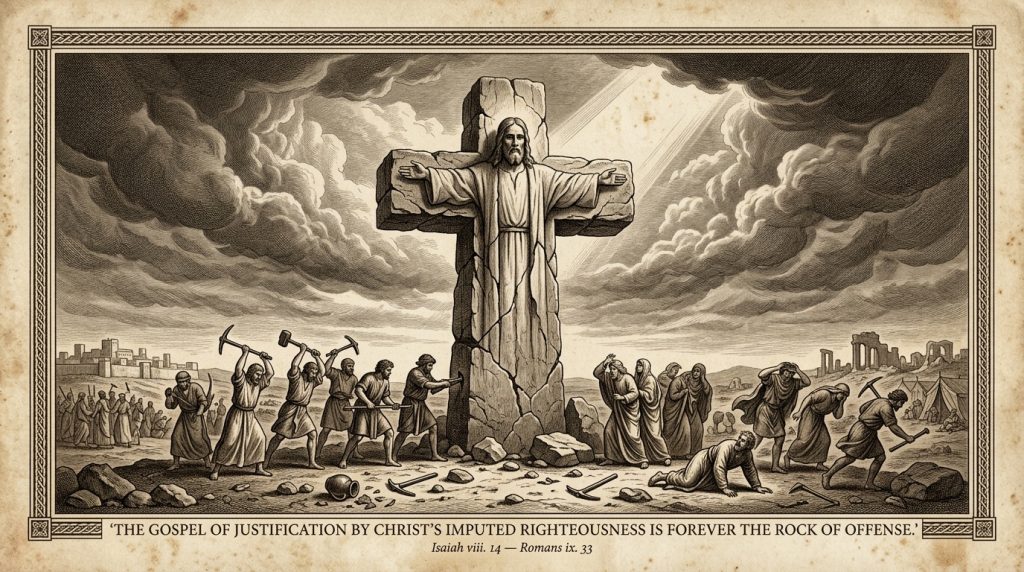
The gospel of justification by Christ’s imputed righteousness is forever the rock of offense. The issue before every member, before every Christian is whether we will fall upon this Rock and be broken (in repentance), or whether that Rock will fall on us and grind us to powder (Luke 20:20).
“By faith apply the blood of Christ to your own hearts, for that alone can make you whiter than snow. But you say, ‘This surrender of all my idols will break my heart.’ This giving up all for God is represented by your falling upon the Rock and being broken. Then give up all for Him; for unless you are broken you are worthless.
When you turn away from the broken cisterns that can hold no water, and in the name of Jesus your Advocate come directly to God, asking for the things you need, the righteousness of Christ will be revealed as your righteousness, the virtue of Christ as your virtue. You will then understand that justification will come alone through faith in Christ; for in Jesus is revealed the perfection of the character of God; in His life is manifest the outworking of the principle of holiness. Through the atoning blood of Christ the sinner is set free from bondage and condemnation; through the perfection of the sinless Substitute and Surety, he may run the race of humble obedience to all of God’s commandments. Without Christ he is under the condemnation of the law, always a sinner, but through faith in Christ he is made just before God” (1 SM. 330).
“What is justification? It is the work of God in laying the glory of man in the dust, and doing for man that which it is not in his power to do for himself” (TM 456).
“Surely shall one say in the Lord have I righteousness and strength: even to Him shall all men come;…In the Lord shall all the seed of Israel be justified, and shall glory” (Isa. 45:24-25).
“The gospel of justification by Christ’s imputed righteousness is forever the rock of offense.“
—— Michael Marsh
Preface
Justification by faith is the great pulsating heart of the gospel of Jesus Christ. There is no truth that Satan hates more than this; for as we are justified alone by Christ’s imputed righteousness, it is inseparable from Christ Himself. As Christ is central to the Christian message, so is justification by the imputed “righteousness which is of faith” (Rom. 9:30-33).
Satan has always warred against “present truth.” In the Apostolic church he warred against the resurrection; now it is preached in every church for it is no longer a present testing truth. So he has done with other truths. But he has bitterly opposed justification by the imputed “righteousness which is of faith” since the first altar was set outside of Eden, for it was, and always will be the present testing truth to each generation and each believer. It is the truth upon which the church or the believer stands or falls.
There never has been a time in the history of Adventism when so many publications are pouring off the press, yet amidst all its multifarious theological releases it has not produced a single book of any size or worth which has dealt adequately or correctly with the Pauline expression “righteousness by faith,” or the “righteousness which is of God by faith” the righteousness by which believers stand justified. If all we knew of Adventism during its history was that it had neglected the justification by the imputed “righteousness which is of God by faith” (Phil. 3:9; Rom. 1:16-17), we would be in a position to conclude that the past has been a period of apostasy and spiritual decline, irrespective of the increase in church membership. God looks for quality and truth, not quantity and neglect of truth. This can also be stated concerning Protestantism in general.
The article you are about to read reveals some reasons for this tragic neglect on one hand, and perversion on the other, of this foundation and capstone of the gospel, this citadel of the Christian’s faith, this cardinal truth and Person whose infinite, eternal righteousness is the quintessence of the everlasting gospel.
Over the years many schemes for finishing God’s work have come and gone; in reading some of the contemporary literature on the subject, it appears we need either more zeal, more work, more numbers, more keeping of the law, or a better understanding of Daniel and Revelation (which books have always been a happy hunting ground for self-appointed would be reformers). It seems we need everything but the gospel. Anything but a clear presentation of justification by the imputed “righteousness which is of faith.”
Apparently by the many following such teachers they are not the only ones who feel that the gospel is not so important after all. All this is a far cry from the teachings of Paul and its reaffirmation by the Reformers of the 16th century. It would appear that many ministers and members within the professed Christian churches, including Adventism, have decided that the “as if,” and “righteousness by faith” aspects of salvation are not really important; while others feel that the Pauline, Reformation light needs reinterpreting. But in so doing they have struck at the heart of the gospel, sending it into cardiac arrest. They are now in the process of unobtrusively carrying the corpse of justification by the imputed ” righteousness which is of faith” out the back door of Christendom, and burying it in the heretical graveyard, along with other theological misconceptions and errors of our spiritual Pauline–Protestant forefathers.
It was the clear teaching of justification by the imputed “righteousness which is of God by faith” alone which shook the world in the days of the Apostles. It was the rediscovery of that great truth by the Reformers that shook the world again in the 16th century, giving to “the beast” that “deadly wound,” and it will be the reaffirmation of that same mighty truth that will, for the last time, shake the world, and lay waste the empire of the that “man of sin,” prior to the coming of Christ.
To Adventism has been bequeath the promise and the power of the Holy Spirit to understand that blessed truth, and present it under the latter rain to a darken world, binding up the law and the gospel in a perfect whole. Who else but Adventism can accomplish this? For to no other church has the spirituality, claims and demands of an infinite, eternal law for righteousness been presented in all its fullness, to prepare for the full proclamation of the gospel. Only in Christ is found the fulfillment and perfection of the
[ 3 ]
“righteousness of the law” (Rom. 10:4; Heb. 5:9), the righteousness which comes alone by faith, imputed for our justification, and in principle and attributes imparted for our sanctification. Justification therefore is seen as the foundation of all true Spirit imparted sanctification (Gal. 3:14; Acts 2:38; 2 Thess. 2:13). To fail here, is to have failed everywhere. To stumble here, is to stumble to our eternal ruin. On the other hand, to lay hold on “the righteousness which is of God by faith,” is to stand before God justified by faith alone. To stand “just as if you were righteous,” and be among those who “turn many to righteousness,” and thus “shine as the brightness of the firmament; and as the stars for ever and ever” (Dan. 12:3. Heb.).
[ 4 ]
Imputed Righteousness
“THE ROCK OF OFFENSE”
“But to him that worketh not, but believeth on Him that justifieth the ungodly, his faith is counted for righteousness” (Rom. 4:5).
Christianity is absolutely unique in that it proclaims the gospel of the God who justifies the ungodly. Many from within the church have tried to soften the blow of this Scripture, and in various ways to take away its force.
It was the Reformation which revived the Pauline message of God’s grace–a grace which accepts the unacceptable. All Christians believe that Christ died for the ungodly. But many will not accept that God justifies– declares righteous at His tribunal – the ungodly; the man who in himself is not righteous but full of sin.
Of course, this raises the question of the righteousness of God’s verdict. After all, did not God instruct the judges of Israel that they should justify only the righteous and condemn the wicked? (Deut. 25:1). How is it that a Judge who is supremely just can justify the ungodly?
Paul’s answer is in the doctrine of imputed righteousness–“the righteousness which is of faith” (Rom. 4:6, 8, 11, 13; 9:30; 10:6).–While it is true that the believer is every wit a sinner in himself, for “In ourselves we are sinners, but in Christ we are righteous” 1 SM. 394),–and will in this life continue to fall short of God’s glory (Rom. 3:23, present continuous tense)–God imputes to him the righteousness of Jesus, even His own infinite, eternal righteousness–“the righteousness of God” (Rom. 1:17; 3:21-22; Phil. 3:9. 1 SM 394). It is on this basis that God can justly declare him righteous before the law and treat him as if he were actually righteous.
The Reformers did not hesitate to talk about this “as if” element of the divine jurisprudence. The doctrine of Christ’s substitutionary work demands it. (The sinner is treated “as if” he were the One who lived that sinless life and died on the cross). The “as if” is the inevitable result of believing in the gospel of salvation by substitution and imputation.
“The only way in which he can attain to righteousness is through faith. By faith he can bring to God the merits of Christ, and the Lord places the obedience of His Son to the sinner’s account. Christ’s righteousness is accepted in place of man’s failure, and God receives, pardons, justifies, the repentant, believing soul, treats him as though he were righteous and loves him as He loves His own Son. This is how faith is counted righteousness…” (1 SM 367).
“When God pardons the sinner, remits the punishment he deserves, and treats as though he had not sinned, He receives him into divine favor, and justifies him through the merits of Christ’s righteousness” (1 SM 389).
“If you give yourselves to Him, and accept Him as your Saviour, then, sinful as your life may have been, for His sake you are accounted righteous, Christ’s character stands in place of your character, and you are accepted before God just as if you had not sinned” (SC. 62).
This is the inevitable blessing of believing in the gospel of salvation by representation, substitution and imputation.
Rome fought this concept bitterly. She maintained that God could not declare a man to be righteous unless he was personally righteous; otherwise God would appear to be a liar. From that day to this, Roman Catholic scholars caricature imputed righteousness as “a pasted on ‘as if’ righteousness.” The Reformation defenders replied that if Rome were correct, no one could be justified in this life, for no one is sinless or can be called righteous if the verdict has to rest on his own experience.
The justification of the ungodly through the imputed righteousness of Christ does not mean that God’s verdict is a fiction which is based on no reality. Before God, Christ’s atonement is a reality which is all-sufficient. It does not need to be supplemented by any other reality. God’s verdict of justification is not grounded on any reality within the believing sinner. This is the “rock of offense” on which Rome stumbled. But not only Rome. It is the rock of offense within Protestantism too. Within Protestantism in general, and Adventism in particular. There is a continual temptation to ground God’s verdict of justification by “the righteousness which is of God by faith of Jesus Christ” on some reality within the
[ 5 ]
believer. Within Adventism regeneration and sanctification is generally included in the Pauline expression “the righteousness of God by faith,” or “the righteousness which is of faith,” the righteousness which we must plead before God for our initial, and continuing justification. (Rom. 9:30; 10:6; Phil. 3:9; 2 Cor. 5:21). This really means injecting something of the subjective element of sanctification into justification, which immediately corrupts the doctrine of both justification and sanctification. This is usually accomplished by including “the righteousness of the law” –sanctification– in with, and as part of, the blessing of “righteousness by faith,” the righteousness by which we must stand justified and accepted, and is “witnessed by the law,” as that righteousness which faith brings which alone “establishes the law” (Rom. 3:21, 31). In this scheme the believer stands justified partly by Christ’s imputed righteousness and partly by imparted righteousness, a very subtle justification by works; however, not seen as such, by those who teach it.
The Subordination of Justification to Sanctification.
To say that Romans 4:5 means that God “forgives the ungodly” avoids the whole problem of imputed righteousness, but it does so at the expense of having a very weak doctrine of justification. Justification only has the negative element of forgiveness left in it and is bereft of the positive element of being declared righteous before the tribunal of God. It becomes a very real temptation to put the sanctified life of the believer in the room of the imputed righteousness of Christ as that which obtains God’s favorable verdict in the final day of judgment.
Then there are others who may even admit that justify means to declare righteous, but imputed righteousness does not seem to be as real to them as does imparted righteousness. They confess that imputed righteousness is necessary for Christian beginners who have nothing else. But sanctification is seen by them as the higher stage of the soteriological process, and justification is very decidedly subordinated to it. They could not be so irreverent as to say this, but it seems that imputed righteousness is to them a sort of make-believe “abracadabra” righteousness that somehow gets you by until you can acquire the real internal righteousness of sanctification. They seem to say:- “It would be a bit too presumptuous or too uncertain to rest on this invisible righteousness alone for salvation. At least the safest thing would be to have some of both–and the more of the second, the safer you would be.” Of course no one would express it as crudely as that, but how can we help suspecting that this is the way they feel when a little justification is swallowed up by an overwhelming preoccupation with inner experience.
Justification in Prospect of Future Righteousness
Early in this century, Lutheran scholar Karl Holl tried to get rid of the offensive “as if” by asserting that God justifies the believer because, being eternal, He sees what the believer will eventually become by Christ’s renewing power. God acts like the sculptor and sees in the raw block of marble what he can make of it. It goes something like this:-
“…his heart (if not his feet) is in the law of promise….That is what God sees; and on the basis of this, God acts….His (the sinner’s) position may not have altered much, but his direction has been changed completely, and it is by direction, not position, that God judges. Once the sinner had his back to Christ; now his face is Christward. This is faith, and it holds the potency of a glorious future. This is what God sees; and seeing it, God declares the man righteous. God “justifies” him. Is this a legal “fiction”? The question answers itself. There is nothing fictitious about it whatsoever. It is the deepest and most genuine of realities.
This is not justification on account of what Christ has done and on the basis of His finished work alone. It shifts the ground of salvation from the vicarious righteousness of Christ to the personal righteousness which the believer will possess–one day.
Another way to get rid of the offensive “as if,” is to declare that regeneration precedes, and is the foundation of justification. In this scheme, God no longer “justifies the ungodly,” but only the regenerate. Again it shifts the ground of our
[ 6 ]
regenerate. Again it shifts the ground of our salvation from the vicarious and finished work of Christ’s righteousness alone for justification to the personal work of the Holy Spirit in the believer.
Why is this done? At the end of the last century (1895), Sanday and Headlman, in their great commentary on Romans, proposed that the doctrine of justification by an imputed righteousness looks as if the Christian life had its beginning in a “legal fiction.” This is what Rome has always said. But it seems that their commentary started a chain reaction to the supposed horror of “legal fiction.” Protestant scholars started a stampede to get rid of this offensive “as if.” Today it is hard to find a scholar, even in Adventism, who stands stiffly for the old doctrine of the imputed “righteousness which is of God by faith,” without stating that that Pauline expression includes sanctification. But what is done by way of an alternative?
Justification ends up being based, in one way or another, on some reality within the believer. Justification is fused with regeneration and sanctification. In grounding justification on an internal reality, different roads may be taken, but they all lead to Rome.
The irony of all formulations, designed to get rid of “legal fiction,” is that they end up with a real legal fiction. The fact of the matter is that even believers are beset by many inner contradictions, as Romans 7:14-25 amply testifies. In Romans 7:15-18, the desires of the flesh are not fulfilled full because of the opposition of the Spirit, while in Romans 7:19-20, the desires of the Spirit are not fulfilled full because of the oppositon of the flesh. Believers are therefore continually seen as lamenting their quality of obedience, not their disobedience in these verses. There is nothing in them–not even their best intentions–which is entirely free from the taint of human sinfulness (1 SM 344). Their faith is not unmixed with the alloy of unbelief. (“Lord, I believe; help Thou mine unbelief”), is still the cry of the converted saint. If God pronounced believers righteous on the basis of any reality in them, this would call the truth of God into serious question.
Justification is a declaration that the believer possesses an absolute infinite, eternal, perfect righteousness; even the infinite, eternal “righteousness of God” Himself in Jesus Christ his Substitute and Surety (Rom. 1:17; Rom. 3:21-22; Rom. 10:3; Phil. 3:9; 2 Cor. 5:21). It ought to be clear that such righteousness is not found in the believer’s good intentions, his attitude, his faith, his Sabbath-keeping or in anything within such a poor worm of a creature. He needs a far better righteousness than anything within him to stand in the tribunal of Almighty God. He needs a righteousness without fault or flaw which mounts up to the heights of the ETERNAL! Holiness as high as the ETERNAL! For that is the only holiness which will satisfy the law. Such a righteousness is found nowhere else but in Jesus Christ, and therefore to base justification on any reality within the believer is a horrendous fiction.
Justification on the Basis of the Believer’s Relationship With God.
The most plausible way of by-passing the doctrine of justification by the imputed “righteousness of God by Jesus Christ” is to propose that justification means God’s declaration that the believer is now in a right relationship with Himself. This line of reasoning uses so many right words, and says so many true things, that we need to be wide awake lest we embrace the counterfeit article while all the while thinking it is the genuine Pauline and Reformation article. The argument goes something like this.
Righteousness belongs to the language of relationships. Justification is simply God’s declaration that a right relationship exists. This is real righteousness. There is no “as if” about it, for it is purely relational. The problem of talking about imputed (fictional) righteousness disappears, because if you talk about having a right relationship with God, the distinction between imputed and imparted righteousness is irrelevant.
This is the line taken by many Protestant scholars. Says one:- A man’s relationship to God is no fiction. God does not treat a sinner as though he were righteous; he is in fact righteous. Through Christ he has entered into a new relationship with God and is in fact righteous in terms of this relationship” (New Testament Theology. p. 445. By G. E. Ladd).
[ 7 ]
If we here pause to clear the air, we should have no trouble taking off the mask of this theory and showing that hiding beneath its plausible terminology is the principle of Roman Catholic justification. We will make three brief points.
(1) Righteousness is certainly a relationship. It means having a right relationship with God, with man and with the whole created order.
(2) Righteousness is not a relationship in the abstract, but it is a living, dynamic thing which is expressed in concrete behavior. It has real ethical content. Thus the man who has a right relationship acts right towards God, toward his neighbors and towards the world around him.
(3) Since God’s justification is not piecemeal but is entire and absolutely perfect, it is a declaration that the believer has a perfect relationship with God, man and the world.
It ought to be clear that no believer has this perfect relationship existentially. If he had, then he would have an uninhibited response of unalloyed love to God every moment of his life like Jesus had. Then he would pray perfectly, and his heart would never wander in the slightest from loving God with the whole soul, mind and strength. Luther confessed that he never was able to say one Lord’s prayer perfectly. He said that we should never doubt that our best and holiest duties are defiled with the secret vice of pride. God’s declaration that perfect righteousness exists is not to be identified with our personal relationship with God. Let any man honestly look into his heart, and he will confess that his heart-relationship is far from what it should be, or could be, and he must needs cry for forgiveness.
But does not the believer have a perfect righteousness? Yes, he has! Does not a perfect righteousness mean a perfect relationship? Yes, it does! How then does the believer have a perfect relationship? He has it by faith and imputation. On his behalf, Christ has a perfect relationship to God, to man and to the whole created order. All that was lost in Adam is restored in Christ.
The relationship which Christ our Representative has with the Father on our behalf must be distinguished from our own heart-relationship with Christ, which the Bible calls faith (that is, faith-union with Christ). This is not the efficacious, meritorious union. Faith always points away from itself to rest for salvation on Christ’s union with God.
It is often said that the most important thing in the Christian religion is the believer’s relationship with the Lord. But as important as that is, it is not the most important thing. The most important thing is Christ’s relationship with God. This is the believer’s guarantee of acceptance unto eternal life. Justification is based on this reality which is completely outside the believer. It is the righteousness or relationship of Another. The believer is not accepted because of his faith–even though he will not be accepted without it. He is accepted because Another is accepted. He is declared righteous because Another is righteous on his behalf.
The objections about “legal fiction” are only a “red herring.” Neither a good Catholic nor a good Protestant will say that God declares a person righteous without the existence of a real righteousness. The Reformation acknowledges that righteousness is necessary to secure God’s verdict of justification. So let us not be diverted by the non-question as to whether a real righteousness must exist. That is not the issue. The issue is. Where does this righteousness reside? Is this righteousness vicarious, or is it a personal righteousness in the believer?
The Issue Behind the Issue.
What is behind all the efforts to rework the doctrine of justification–efforts which lead in one way or another to grounding God’s justifying verdict, at least in part, on some reality within the believer? Back of them all is a dissatisfaction and uneasiness about the plain Pauline and Reformation doctrine of imputed righteousness. It is disappointing that even many good authors, within and without of Adventism, who confess that salvation is based on an objective foundation, seem to be soft on the old doctrine of the imputed “righteousness which is of God by faith of Jesus Christ.” The whole concept of imputation is tied to the Biblical doctrine of a substitutionary atonement. These two things–imputation and the substitutionary atonement of
[ 8 ]
Christ–stand or fall together. An attack on one is an attack one the other. Therefore, the real issue behind all issues from its inception in heaven to its finality on earth is the law of God.
The center of the Apostolic message was that Christ died for our sins (1 Cor. 15:3), was made a curse for us (Gal. 3:13), suffered, “the just for the unjust” (1 Pet. 3:18), and gave His life “a ransom for many (Greek, “anti,” meaning “in the stead of.” Mk. 10:45). In Him, through His life and death God fulfilled and satisfied His infinite, eternal spiritual law.
“God was in Christ, reconciling the world unto Himself, not imputing their trespasses unto them…For He hath made Him to be sin for us, who knew no sin; that we might be made the righteousness of God in Him” (2 Cor. 5:19-21).
God laid our sins on Jesus Christ by imputation. “…He was numbered (‘reckoned’ Lk. 22:37. Gr. “imputed”) with the transgressors….” (Isa. 53: 12). This was how He was “made to be sin for us.” There was nothing in Him worthy of death. But having been made to be sin by imputation, He was condemned by the righteous judgment of God. In this sense it was right and proper that Christ should suffer the wrath of God. He had to be treated as if He were a sinner. Christ knew that He was sufferings under the just and righteous judgment of God, but He also trusted in that same justice of His Father to rise Him up because He had done no personal sin. It is on this same basis that God deals with the believing sinner. Having made** him righteous by the imputed righteousness of Christ, God pronounces him just and treats him as if he were righteous. Those who repudiate imputed righteousness are really repudiating the central truth of the cross of Christ–that is substitution. ** Used in the sense of objectively made, not subjectively made. (See 2 Cor. 5:21, for use of the word “made.”)
But let us press this matter in order to get back to the ultimate source of the problem. Why have so many Biblical scholars began to look for the meaning of Christ’s atonement elsewhere than in the concept of substitution. They talk about Christ’s solidarity, identity or oneness with the race. Some give excellent presentations of Christ’s representative role. But cannot bring themselves to acknowledge substitution. To many, the whole substitution–imputation concept is unreal and unnecessary. They are critical of the typical “Fundamentalist” portrayal of Christ’s substitutionary work–and often for some very good reasons, we must admit. For is it not all too true that some presentations of Christ’s substitutionary atonement appear to be arbitrary, artificial and not wholly unlike a pagan appeasement? Why does not God simply forgive without having to be “bought off” by the blood sacrifice of Jesus Christ? It appears to many that God is punishing an innocent victim.
But was Christ an innocent victim? In Himself, yes! But by substitution and imputation, no! Hanging on the cross Christ was the offending party. Before the law He was the sin and guilt** of every son and daughter of Adam, and God justly punished Him in our place, until He had exhausted the penalty of justice. Justice demanded that He be treated so. Thus we have been saved justly without God sacrificing the honor and integrity of infinite, divine justice. God has saved us without waiving the claims of the law; without an amnesty. In Christ He has fulfilled and satisfied both His law and covenant. In Christ He has upheld and honored both His throne and government. In Christ He can be just in forgiving sins and justifying the ungodly (1 John 1:9; Rom. 3:26; 4:5). That same justice now demands that the sinner be treated as Christ deserves.
** Christ took our guilt on Calvary, and not as some who teach the “moral influence theory of the atonement” would have us believe, that He only took the responsibility for our sins. Responsibility is one thing, guilt is entirely another thing. (See “Can God be Trusted” Vol. 1. 227).
“By reason of the sacrifice made by Christ for fallen man, God can justly pardon the transgressor who accepts the merits of Christ” (1 SM. 396).
The substitutionary atonement cannot be explained except by an appreciation of the binding claims of the law of God.
“Those only who acknowledge the binding claims of the moral law can explain the nature of the atonement” (1 SM. 229).
[ 9 ]
“Those only who have a just regard for the law of God can rightly estimate the atonement of Christ which was made necessary by the violation of the Father’s law” (1 SM. 232).
The testimony–The Ten Commandments are the words or the stipulations of the “everlasting covenant” (Ex. 34:27-29; Deut. 4:13; Rev. 11:19; 15:5).
The covenant guarantees the blessing of life to the obedient and invokes the curse of death upon the disobedient. This law is the constitution of the universe. When faith brings God’s supernatural, infinite, eternal righteousness and life to it in Christ, the law witnesses to such righteousness and life as that by which it is established (Rom. 3:21, 31). It cannot be changed, modified or relaxed. God must uphold the moral order of the universe. The law’s demands must be honored by perfect infinite, eternal fulfillment and by most complete satisfaction for sin. Thus the life and the death of Christ were absolutly nesessary for man’s salvation. BOTH constitute the “righteousness of God in Christ.”** If this appears rigidly severe, let it be understood that we dealing with an exact and omnipotent justice which will not abdicate the rule of divine law. Ultimate stability and freedom are not found in weakening, much less abolishing, the law of God.
** “Knowing himself to be a sinner, a transgressor of the holy law of God, he looks to the perfect obedience of Christ, to His death upon Calvary for the sins of the world; and he has the assurance that he is justified in the merits and sacrifice of Christ….The active obedience of Christ clothes the believing sinner with the righteousness that meets the demands of the law” (SD. 240).
“By His spotless life, His obedience, His death on the cross of Calvary, Christ interceded for the lost race” (BC 7. 930).
“For if when we were enemies, we were reconciled to God by the death of His Son, much more being reconciled, we shall be saved by (in) His life” (Rom. 5:10. GK).
Most Protestants place their emphasis entirely on the blood–the cross–, not looking back to His commandment keeping life. For this reason, most are very weak on the commandments. Nor do they look beyond the cross to His heavenly ministry. Thus they are very weak on Christ’s ministry in the heavenly sanctuary.
When we acknowledge that this “law is holy, and the commandment holy, and just, and good” (Rom. 7:12), that it requires of us the most perfect and exact obedience, even the eternal, infinite “righteousness of God,” that its penalty for any default must be carried out, and that it would be easier for heaven and earth to pass away than for one jot or tittle of this law not be carried out.
Then we will bless God that means have been devised that a Substitute stand in our stead. We will bless God for His sinless life and death which met our obligations. We will thank grace that He was willing to make reparation for the damage done. We will know why God could not spare His own Son if He were to save us from eternal ruin (Rom. 8:32). The sufferings of Christ will impress upon us what a tremendous evil it is to transgress God’s commandments. The law will terrify the believer more when he sees that Christ, the Son of God, had to fulfill it for him than it would were it preached to him without the mention of Christ and of such great torment suffered by God’s Son. Only then in this light will we have a just conception of the greatness of the spiritually of the law, and the greatness of our justification before it by what it took to fulfill and satisfy it on our behalf –“the righteousness which is of God by faith of Jesus Christ,” even “the righteousness of One“–Jesus Christ (Phil. 3:9; Rom. 5:18).
We submit that such a view of the atonement shows that there is no salvation other than by substitution and imputation. More than that, it is a salvation which will lead to a life of penitent, graceful submission to the law of God–apart from which all freedom is an illusion. It is not the Reformation doctrine of justification by the imputation of Christ’s infinite, eternal “righteousness of God” which is a cul-de-sac with no road to ethics. Rather, the blind alley is found in the theories of atonement that are not grounded on the moral necessities of the law of God. A justification as seen in Christ as upholding the law, and keeping the covenant faith will produce believers who will uphold the law and keep the covenant faith. A law and
[ 10 ]
covenant honoring way of salvation as seen in Christ will bring forth law and covenant honoring behavior. A salvation and redemption as provided in Christ by His fulfilling and satisfying the law on a vertical level, will produce saved believers who will fulfill and satisfy the law on a horizontal level.
We live in an age which has become notorious for its spirit of lawlessness–“lawlessness shall abound.” “Depart from Me ye workers of lawlessness” (Matt. 7:23; 24:12 Greek). That spirit has permeated the churches well as the world. Multitudes of proposed Christians do not want to submit to the outside law of God any more than they want to submit to the outside “righteousness which is of God by faith” (Rom. 3:21-22; Phil. 3:9; 10:3). They want to live by some “Spirit-ethic” (the uncertain voices within, “sanctified human intuition”) just as they want to be justified by some “real” righteousness within. But it is “the man of lawlessness” (2 Thess. 2:3-8, RSV) who opposes justification by faith by crying up the need for real inward righteousness while all the while his heart “thinks to change times and law” (7:25 RSV).
In short, all this opposition to imputed righteousness stems from the spirit of rebellion against the law of God. Let the law of God be upheld in all its infinite, eternal righteousness; in all its spiritual fullness, and its spiritual claims urges home upon the conscience, then Christ’s substitutionary atonement stands, and troubled consciences will be glad to find fulfillment and shelter in, and under His imputed, justifying righteousness. Christ and His righteousness will then become more than all the world to the believer.
God’s verdict of justification, therefore, is grounded on the reality of the law of God as fulfilled in the sinless life and death of Christ upon the cross. Those who want to ground it on their own reality in part or in whole dishonor the law and despise the all-sufficiency of the life and death of Christ—the all-sufficiency of the timeless, eternal principle of the cross, as seen in both His active and passive obedience. Therefore, to teach that justification must be grounded on regeneration–, the Spirit’s work within–, or to include sanctification in with the blessing of “the righteousness which is of God by faith of Jesus Christ” by which we stand justified, is to declare that God’s own infinite, eternal righteousness in Christ is not only not enough, but that it is not sufficient enough to give one a perfect standing before God and His law, and that some of our own righteousness– whether Spirit wrought or not– in part or in whole must be added to it to make it complete, is one of the must subtle and deceptive forms of legalism, antinomianism and lawlessness. It is at the heart of the “mystery of iniquity.” All this is implicit in Paul’s argument in Roman 3:21-31.
Then, in Romans 4, Paul presses his argument further against those who want to base God’s justifying verdict on a reality within themselves. The God who justifies the ungodly (v. 5) is the God who creates out of nothing and who raises the dead. Paul shows that this is the God in whom Abraham believed. When his own body was procreationally dead and Sarah’s womb was dead, God pronounced him a father, saying, “I have made thee a father of many nations” (v. 17). This was not said after Isaac was born but before Isaac was born (see Gen. 17:5). God’s declaration that Abraham was a father was not based on a reality in Abraham. The God who creates out of nothing (Heb. 11:3)–not being dependent on any reality save the reality of His own Word, who is Jesus Christ–is the God “who quickeneth the dead, and calleth those things that be not as though they were” (Rom. 4:17). This assertion of Paul is a thunderbolt against those who say that a man has to be righteous, or regenerated before God can declare him righteous. And when God raises the dead, He is not dependent upon some supposed immortality of the soul. God’s word calling the ungodly righteous and the barren woman a mother is, like election itself, not grounded upon the foreseen righteousness or fruitfulness of the human subject, but on the reality of Jesus Christ and His work alone. God finds in Jesus an adequate reason and justification for all His decrees.
To insist that we must be righteous before God by a righteousness within is as foolish as thinking vain thoughts about surviving the disaster of death by our supposed immortality. Saying that the righteousness which we have within is by the grace of the Holy Spirit does not improve the situation. If anything, it makes our situation worse. It means we use God’s gift to steal His glory.
[ 11 ]
Righteousness by Faith Alone.
When Paul tells us in Romans 1:17 that the righteousness is “from faith to faith,” he means that it is by faith from start to finish. It is as if he said that it is by faith and nothing but faith–sola fida, by faith alone. He backs this up by saying that it is a righteousness “with out the law” (Rom. 3:21), “without the deeds of the law” (Rom. 3:28), and “without works” (Rom. 4:6).
It has been argued by all good Romanists and by all poor Protestants (in one way or another) that the renewal and sanctification of the believer must be included in this Pauline article of “righteousness by faith.” We will endeavor to show (1) that this does violence to the structure of the book of Romans and (2) that this is in direct opposition to Paul’s line of argument in Romans.
The Structure of Romans.
All are agreed that Romans 1:16-17 is Paul’s introduction to the theme of the book. The theme is succinctly stated when the apostle says” “…as it is written, ‘he who by faith is righteous shall live.’” (RSV)
Here we have (1) condition (righteousness attained by faith) and (2) result (life).
Furthermore, in this first section (Rom. 1:18 to 4:25), where faith and believe are used repeatedly, Paul often connects them with the word “righteousness” (see Rom. 3:21-22, 25; 4:3, 5-6, 9-13, 21-24). Throughout Romans 3 and 4 Paul is not talking about the believer’s holiness of life but about righteousness being imputed.
In the second section (Romans 5-8) Paul swings his attention to the life the “righteousness by faith” brings to us. He talks about the life of the believer both here and in the hereafter. It is described as a new life, a Spirit-filled life, a glorified life and a holy life. It is generally acknowledged that Romans 6, 7 and 8 are talking about sanctification. In Romans 6 Paul even uses the word “righteousness” a number of times. Here he is referring to the believer’s actual righteousness of life (see vv. 13, 16-20). But in this context he never uses the word “faith.” In fact the word “faith” is not mentioned after Romans 5:1 until the Apostle deals with justification again in Romans 9:30-33. The apostle thereby makes a clear distinction between the “righteousness of faith” (chapters 3-4) and the righteousness of life (chapters 5-8). In Romans 8:4 the righteousness which is wrought in the believer by the Holy Spirit’s indwelling is called “the righteousness of the law.”
Another remarkable feature about the structure of Romans is that in the section where Paul is explaining the article of “the righteousness of faith,” he makes no mention of the Spirit. But in the section where he deals with the believer’s righteousness of life (“righteousness of the law,” Rom. 8:4), the Spirit’s indwelling is mentioned repeatedly. So the apostle makes a clear distinction between “the righteousness of faith” (a righteousness which was wrought out in Christ) and “the righteousness of life” (a righteousness wrought out in the believer by the Holy Spirit).
All this proves that the “righteousness which is of faith” is what is done for us, and righteousness of life is what is done in us. Here are root and fruit.
The Line of Argument in Romans.
When we follow Paul’s line of argument closely, we see that there are several powerful reasons for excluding sanctification from “the righteousness which is of faith” alone.
(1) “Faith alone” is our acknowledgement that the righteousness which God has provided and made known to us in the saving gospel is all-sufficient. It has been wrought out, presented to God on our behalf, and accepted. Faith does not bring it into existence but confesses its existence. “Faith alone” means that the righteousness of God provision is everything necessary for our salvation, and nothing remains to be added to that perfect work. But when we come to talk about sanctification, this “faith alone” language would be most inappropriate. The righteousness of life is not yet complete in the best of saints, and much yet remains to be added to our spiritual attainments, as 2 Peter 1:5-8 testifies.
(2) “Faith alone” means that the righteousness of God’s provision is not seen (Heb. 11:1). This righteousness is declared to us in the gospel and
[ 12 ]
is only believed on and seen with the eye of faith. When the New Testament talks about sanctification, however, it talks about a righteousness which can be seen in loving deeds (Matt. 5:16; 1 John 3:7-18). Jam. 2:14-26; Eph. 4:5; Titus 2:11-12). In this life we are righteous before God only by faith–meaning that we are not righteous before God by love, renewal or our lives of obedience, for this inward work is only begun in us and will not be completed until glorification.
(3) “By Faith” means that the righteousness which God provided for our salvation is “without the law,” without the deeds of the law,” and “without works” (Rom. 3:21 28; 4:5-6). Here is a righteousness in which all our efforts, works, cooperation, participation and obedience are shut out. This is why Luther called it a passive righteousness. It would be most inappropriate to talk about sanctification as being by faith alone. In fact James states that this faith if it is alone is dead. To be sure, living a life of holiness depends on faith, but not faith alone. True Protestantism never maintained the absurd position that we are sanctified by faith only, although at least one Adventists writer does (See “Beyond Belief” p. 101, 103, 109. J. Sequeira).
The business of living a holy life–what Luther called active righteousness— is not without meaningful human activity. The New Testament does not hesitate to speak of the necessity of human effort in cooperation with divine grace. The Christian life is often depicted as a battle, a march, a fight. We are not only told to pursue holiness, but we are warned that it will involve conflict and much tribulation (2 Tim. 2:3-4; Eph. 6:10-18; 1 Tim. 6:11-12; Heb. 12:14; Acts 14:22 etc.). The Spirit is not given to do everything for us. We must not speak of the work of the Third Person of the Godhead in substitutionary terms. The Holy Spirit does not negate the need for responsible human effort. Rather, He enlists the human faculties in the great work of Christian sanctification.
“The righteousness of the law” is to be “fulfilled in us, who walk not after the flesh, but after the Spirit” (Rom. 8:4). As Christ is the source of this imparted righteousness, it is not fulfilled by us, but in us. Since these fruits are the attributes of the divine nature, they cannot be produced by human effort from a human source. They are produced by the working of the Holy Spirit, who imparts to the believer these attributes of the character of God and beautifies the human character. But though this work is not accomplished by human effort, neither is it done without our cooperation and intelligent human effort. Our indwelling sinfulness makes necessary that Christ be the source for both imputed and imparted righteousness (Col. 1:29; Phil. 2:12-13; Heb. 13:20-21; Eph. 2:9-10; Rom. 11:36; John 15:1-5. DA 300).
[ the following paragraph is marked with a hand-drawn bracket in the margin of the original ]
Once the Pauline article of “righteousness by faith” alone is allowed to spill over into sanctification, not only is the glorious gospel ruined, but sanctification is ruined too. It becomes poisoned with a sickly, dehumanizing view of sanctification which, if really carried out, would reduce man to the level of a pious zombie who is just a suit or glove which Jesus wears. The sections of the New Testament Epistles which deal with sanctification do not sound anything like Quietism (let go, and let God). The apostles’ doctrine has none of this mystical sanctification by faith alone. Nor is it found in the writing of E.G.White. That justification is by faith alone she affirms (1 SM 389, 330. SC. 60); that sanctification is by faith alone she denies (AA. 530-533. 560-561. 1 SM. 377-382). This is in harmony with the plain teaching found in James chapter 2.
(4) “By faith alone” means that only faith is counted for righteousness.
“For what saith the Scriptures? Abraham believed God, and it was counted unto him for righteousness…..But to him who worketh not, but believeth on Him that justifieth the ungodly, his faith is counted for righteousness. Even as David also describeth the blessedness of the man unto whom God imputed righteousness without works…” (Rom. 4:3, 5-6, 20-24).
Faith alone is counted for righteousness—not love, hope, joy, peace, goodness or anything else. This is not because faith is a virtue that outshines all others. “Faith is not our Saviour,” our righteousness, nor does it have any special merit in itself. “It earns nothing. It is the hand by which we lay hold upon Christ, and appropriate His merits , the remedy for sin” (DA 175). We must be careful at this point that we do not make faith run competition with the
[ 13 ]
Saviour. He alone is our righteousness and salvation. In our place and in our name He lived a life of perfect righteousness necessary for entrance into eternal life. As our Substitute, He died on the cross to make satisfaction to the law for our sins. God was pleased to accept His work on our behalf and to impute it to us on condition that we believe on Christ. (Not meritorious condition, but instrumental condition).
The relation between the objective act of redemption and the subjective appropriation of faith may be illustration by an event in American history. On January 1, 1863, Lincoln declared a general emancipation of American slaves. When the individual slave heard and believed what Lincoln had done, he thereby applied it to himself and became personally free.
There are two sides to the transaction called “righteousness by faith.” (1) Faith. (2) is counted for righteousness. On the human side there is faith; on the divine side there is imputation of righteousness.
Let us look first at the human side of the transaction. The poor, condemned sinner hears that God has already acted in Christ and provided for him a perfect righteousness whereby he can stand in the judgment of God. He hears that Christ’s sinless life, bitter sufferings and death where actually for him. Christ was his legal Surety, Substitute and Representative, And God is prepared to reckon Christ’s life and death as his if he only accept them. Now this poor lost sinner is so helpless that he cannot of himself believe on Christ or come to Him. But God calls him by His Word, enlightens him by the Holy Spirit, and enables him to savingly believe.
Let us now look at the divine side of the transaction. “God imputes righteousness without works” to this man. The righteousness He imputes is “the righteousness of One” or “the obedience of One” (Rom. 5: 18-19). The word impute (logizomai) means to reckon or to account. It does not in itself change the object, but it changes the way the object is regarded. In this case it means that the believing sinner is credited with Christ’s doing and dying. The believer stands before the bar of divine and infinite justice as if all those beautiful deeds and works were his own.
On the ground of Christ’s imputed righteousness, God can justify the ungodly (Rom. 4:5) who believe on Christ. It is not a question of “how can He do that?” (Rom. 3:26). In the verdict of the divine court, the believing sinner is justified (Rom. 3:24-28). This does not mean that he is made righteous, but it means that he is declared righteous.
Justification has to do with judicial categories. It is not something done in the sinner by the Holy Spirit, but it is simply a judgment, a decree, or a verdict of the Judge. That is the plain sense of what justify means wherever it is used in contexts throughout the Bible (see Deut 25:1; Matt. 12:36-37; Rom. 2:13; Pro. 17:15; 2 Chron. 6:23; 1 Kings 8:32; Luke 7:29).
The Relationship Between Righteousness by Faith and Justification by Faith.
We are now prepared to consider the precise relationship between the Pauline righteousness by faith and justification by faith.
In the first place, it would not be wrong to say that these two expressions are more or less synonymous. “Righteousness of (or by) faith” always appears in the contents of justification by faith. In the Greek, “righteousness” is “dikaiosune,” and “justification” is “dikaiosune”–exactly the same. It could also be pointed out that whereas Galatians 3:21 has “righteousness” in the Authorized Version, the Revised Standard Version has “justification.” The Translators substitute one word for the other in Romans 10:4, 10, and 8:10 (See AV, RSV, NEB, etc.).
Yet it might also not be wrong to argue for a technical difference. After all, Translators agree that “dikaiosune” should be translated as “righteousness” rather than “justification” in a number of passages, even when connected with faith. “Righteousness means a right relationship which finds expression in right behavior. It means obedience to the law of God, a righteousness which is so flawless that it can be considered right in the eyes of God. The word “justification” does not have the same ethical content, because it is purely forensic.
The law demands a righteousness with ethical
[ 14 ]
content, and this the sinner owes to the law, but he is incapable of rendering it. Yet by faith he can bring the righteousness of Christ–all that the law demands of him–and God places the obedience of Christ to the sinner’s account. Having made him righteous by imputation, God justifies or declares him righteous (Rom. 3:21 to 4:25. 1 SM 367, 387-396).
Just as “righteousness” is the condition for salvation, so “righteousness is the condition for being justified (Rom. 2:13). Justification is the verdict of the Judge that a men is saved and shall surely live (Rom. 5:9, 18; 1:17; 10:10). By faith the believing sinner attains to righteousness and can thereby stand approved in the judgment of God. Strictly speaking, then, being justified is the result of becoming righteous (imputatively) by faith.
Throughout this study we have followed a line of thought to show that “the righteousness which is of God by faith” does not refer to any subjective quality in us, nor does it refer to the Spirit’s work in us, but it is entirely objective to us. It is first the righteousness of God—the righteousness of His provision. It is the righteousness of Christ—the deeds and acts of incarnate Deity. It is apprehended by faith alone—meaning that it is not seen or felt by us. It is a righteousness which comes “without the law,” “without the deeds of the law,” and “without works”–meaning the righteousness done and found in Another is counted as ours. And finally, it is a righteousness which justifies and saves us to eternal life—meaning that with utmost simplicity we can say that we are saved solely by faith in the objective doing and dying of Jesus Christ. This is the “offence (or stumbling-stone) of the cross, which is “laid in Sion”– the church, not in the world, which has not ceased (Gal. 5:11). Or to state it more plainly Christ Himself is “that Stone of stumbling and Rock of offence (Isa. 8:14; Rom. 9:30-33; 1 Pet. 2: 5-8).
Israel stumbled over that Rock, by “being ignorant of God’s righteousness, they did not submit themselves to the righteousness of God” (Rom. 10:3). Rome also stumbled over the same Stone. “Opposing and exalting himself above all that is called God” (2 Thess 2:4). And to Protestantism in general and Adventism in particular, Christ, and His righteousness have become the same “stumbling Stone and Rock of offence.” 1888 proves it; the last 108 years proves it. In one way or another they will continue to stumble to their ruin. Protestantism by separating the law from justification (substituting Sunday for Sabbath–the real rest of faith. Or by rejecting the “as if” of imputed righteousness, thus repudiating the central truth of the gospel– “substitutionary atonement,”–, and “imputation of righteousness.” Likewise, Adventism will end up with the same result by including the law (the experience of sanctification) in with, or as part of, the “righteousness which is of God by faith” by which we initially, and continually receive the blessing of justification by imputed righteousness, in order that God may continue to impart the Holy Spirit to sanctify us.
Once we include sanctification in with, or as part of the “righteousness which is of God by faith” by which we are justified, we are really confessing that Christ’s imputed righteousness– “the righteousness which is of God by faith” is not enough to give us a perfect standing and acceptance before God, therefore we need some of the imparted righteousness by the Holy Spirit to make it complete. This also will be seen to repudiate the “as if,” and wipe out the truth of substitution. In other words, in this scheme of teaching, “righteousness by faith” means we are justified partly by Christ’s work for us, and partly by Christ’s work in us. This is a very subtle and fatal form of legalism. It too brings the righteousness of the law down to the low level of sinful humanity, and also wipes out substitutionary atonement and the “as if” of imputation, by grounding justification and acceptance in part on the regeneration and sanctification in the believer.
It was the truth of justification by the “imputed righteousness which is of God by faith” which gave the deadly wound to that “man of sin” nearly 500 years ago; for he who used the “sword” –“the Word of God”–deceitfully was “wounded by the sword” (Rev. 13:10, 14). It is by the continual rejection, or neglecting of that same truth that the “deadly wound” will finally be healed. On the other hand, it is by the revival and preaching of that same precious truth that the “sword of the Spirit, the Word of God,” is to forever kill the beast (Eph. 6:17; Rev. 13:10).
[ 15 ]
To those who, enlightened by the Spirit, hold and teach this truth to be self evident, that sinful beings can only fulfill the law in the absolute sense to satisfy infinite, eternal justice and therefore stand justified before a holy God by the imputed “righteousness which is of God by faith of Jesus Christ, is given one of the most precious and glorious promises, specially related to these last day:-
“And they that be wise shall shine as the brightness of the firmament; (and who are the wise?) and THEY THAT TURN MANY TO RIGHTEOUSNESS (Hebrew “tsadaq” TO BE JUSTIFIED”) as the stars for ever and ever” (Dan. 12:3).